


If you've never tried one of these two winter sports before, you'll probably have a dilemma - should I learn to ski or try snowboarding? Maybe you've already asked someone for advice and you've received mixed, often conflicting information about which sport is better, which is easier to learn, which is more affordable in the long run, etc. With the best of intentions, people will very easily make you totally confused.
It is precisely for this reason that we are writing this text, so that as experts in the field of winter sports we can give a clear and unequivocal answer to the eternal dilemma - which is better, skiing or snowboarding?
It isn’t easy to generalize, after more than 10 years of experience in training others skiing and snowboarding skills, we can say that the rule is the following - in relation to snowboarding, skiing is easier to learn but it is more difficult to become a good skier than a good snowboarder.
What exactly does that mean?
This means that it is easier for people to learn the basics of skiing. The reason is a more natural position of the body and legs during movement. Namely, when you ski, your legs are separated and your face is turned in the direction of movement, while when you ride a snowboard, your legs are put together (tied to one board) and your face is turned towards the slope of the slope. This position is uncomfortable for most beginners and it causes insecurity.
However, for the same reasons, it is much more difficult to become a good skier than a good snowboarder. The point is that it is not at all easy to master advanced turning techniques when you have to control two skis, which is not the case with snowboarding, where the techniques of changing direction are learned extremely quickly, as soon as one gets rid of the initial discomfort.
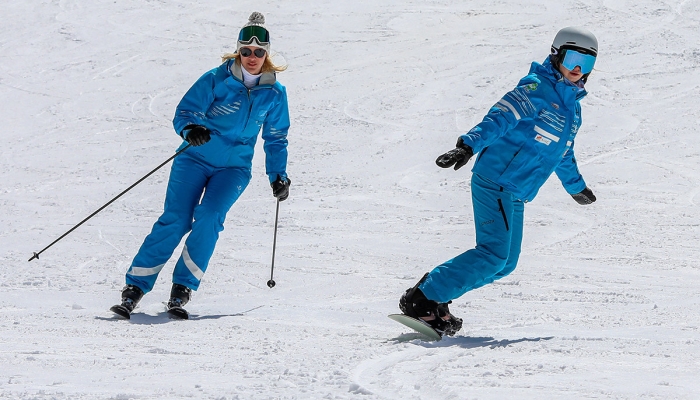
Skiing: natural body position, legs are apart, eyes follow the direction of movement more easily.
Snowboard: lateral position of the body, legs are tied to one board, the direction of movement is at 90 degrees in relation to the natural position of the head, which makes it difficult to become aware of the environment and the movement of the body in the environment.
Skiing: It contains multiple elements that must be carefully adjusted precisely because of the greater freedom of movement of the whole body that skiing allows. Basically, other than jacket and pants, you need skis, ski boots, poles and goggles.
Snowboarding: less complicated equipment that is softer and more comfortable (primarily boots). Also, when riding a snowboard you don't need poles, which are mandatory in skiing, but a helmet is used much more often than in skiing at the very beginning.
Skiing: it is easier to find balance because legs are separated, skiing as a sport carries the risk of knee injury, most often during rotations (change of direction).
Snowboarding: since the legs are connected to one board, injuries are more common during learning, and rarely occur after a person has mastered snowboarding as a skill. The upper extremities, wrists and shoulders should be taken care of the most.
Skiing: it is much easier to use the ski lift as a skier than as a boarder, primarily because you don't have to take off your skis and you have poles to push yourself off the lift.
Snowboarding: Snowboarders must have one leg free to use vertical transport on ski slopes. Also, since they don't have canes, it's a little harder for them to get off the lift. Fortunately, snowboarding shoes are flexible enough to allow for easy movement by keeping one foot on the board and using the other to push off on the snow (much like riding a skateboard).
Skiing:carrying skis and poles in your hands while moving in stiff ski boots isn’t easy. Fortunately, the enjoyment of skiing makes up for and exceeds any discomfort that carrying gear off the slopes can cause.
Snowboard: very easy to wear, the boots are softer and moving on the snow is much easier in them than in ski boots.
At the end of this text about the similarities and differences between these two winter sports (which thanks to Skiadathey are no longer), we will give you a few more tips, based solely on our vast experience and the fact that we as a ski school ski school dhave so far trained thousands of beginners to enjoy the snow.
1. Think about which sport suits you more If you have, for example, ridden a skateboard, it stands to reason that you already have the balance you need to ride a snowboard. If you've ridden rollerblades, you're probably familiar with the feeling of your leg tight in a ski boot, as well as the position of your body (slightly bent lower legs), which is the same as when skiing.
2. Think about personal preferences. Deciding whether to ski or snowboard depends a lot on what your preferences are - whether you want to make sharp turns on the slopes like a skier or enjoy bumps and ramps like a snowboarder.
3. Always try skiing first This is the most solid advice that we can give you, for only if you try skiing first you will know which one of the two sports is better for you. We say this, because our experience has showed that those who start riding a snowboard rarely get on the skies, whilst skiers often master both of this skills.
Finally, you don’t have to brake your head about it. Come to Skiada and try both and then decide what suits you better. By the time the snow falls you will be a formed skier or a snowboarder, whatever you like more.
 English
 Serbian
 Russian